
Seven Sisters Concord
The Seven Sisters Concord is a bloc of seven inhabited worlds around a single dim star, governed not by a crown but by seven sovereign Seats that meet in the repair bay of a chartered tender because no world will sit as another world's guest. It builds the aerospace frames most of human space learns to fly on, it rates its own citizens as pilots, and it keeps records with a thoroughness that has repeatedly proved inconvenient to the people keeping them.
The Concord's constitutional instrument is the Act of Seven of 2864, as amended by the Amendment of the Septet on 14 Sixthmonth 2900, signed aboard the tender Ordinary Weather holding station eleven light-seconds off Wick, one bay wall open to vacuum, all seven Voices in suits with their gauntlets stripped to the liner so the stylus would read. Four pages. It converted seven imperial marquessates into sovereign Seats held of their own worlds, abolished every other imperial dignity inside TRAPPIST-1 outright and vested those holdings in the world assemblies, and kept the writ-debt alive.
That last clause is the one that matters. Under imperial law every rank was a countable obligation stated on its patent. The Concord is the only successor state that preserved the debt in full and made it owed to an assembly rather than to a crown. Other blocs kept their writs by keeping somebody to collect for. The Seven Worlds kept theirs by abolishing the collector.
Character
The Concord's founding argument was about who a noble owes, and its answer was: the people on the ground. A Voice holds a Seat, not a title of grace, and the Seat carries a schedule of deliveries, ratings and prices that an assembly can audit and enforce. This produces a bloc that is genuinely, structurally accountable, and also a bloc where every quarrel eventually becomes a documentary quarrel, settled by producing a book.
It is a culture of competence rather than grandeur. Hearthmoor's founding patent obliged the house to supply defense sets to the settlements of the Septet at schedule price, whoever asks, three words the founder wrote into the margin himself and made the Heralds seal. Seven hundred years later a neighborhood defense wing on any Concord world can still order Hearthmoor at a price it can afford. Kestrel Line's patent obliged it to rate three hundred pilots a year, which is why citizen-pilot doctrine became the Concord's largest export and its largest exposure. The Sisters do not romanticize any of this. They invoice for it.
What the bloc is bad at is admitting a mistake that would cost a Seat. It kept attainder, corruption of blood and the striking of a catalogue prefix verbatim from the empire it had just fought, on Adela Chandler's argument that her own Seat existed only because House Draye had been erased, and that Draye would come back through her front door if erasure were abolished. Six Voices thought the clause barbarous. It stayed in. The result is a state that can void a family permanently and then find itself unable to reopen the question, because reopening one attainder reopens every title standing on one.
The clearest illustration is the bloc's memory of its own exiles. The Concord's registers record that the attainted Eighth Flight took a key at the Gambit in 2931 under Emmeth Kol, with nineteen hulls, and every Seven Worlds source says the same. It is wrong. The founder and signatory was Sanne Kol, born 2876, granddaughter of a pilot pardoned in 2861, who reached Bellhouse in 2926 with four frames, eleven pilots and one column cut from that pardon roll, took the third key, and wrote the recovery law the crew still elects its captains under. Emmeth Kol was her successor, the Second Flight-Master, and his nineteen hulls were the price of being let in. Nineteen hulls are countable and a column of paper is not, and a bloc that keeps its accounts in tonnage writes down the tonnage. Her name did not appear in a Concord document until 3270.
History
Houses
- Chandler Yards (prefix
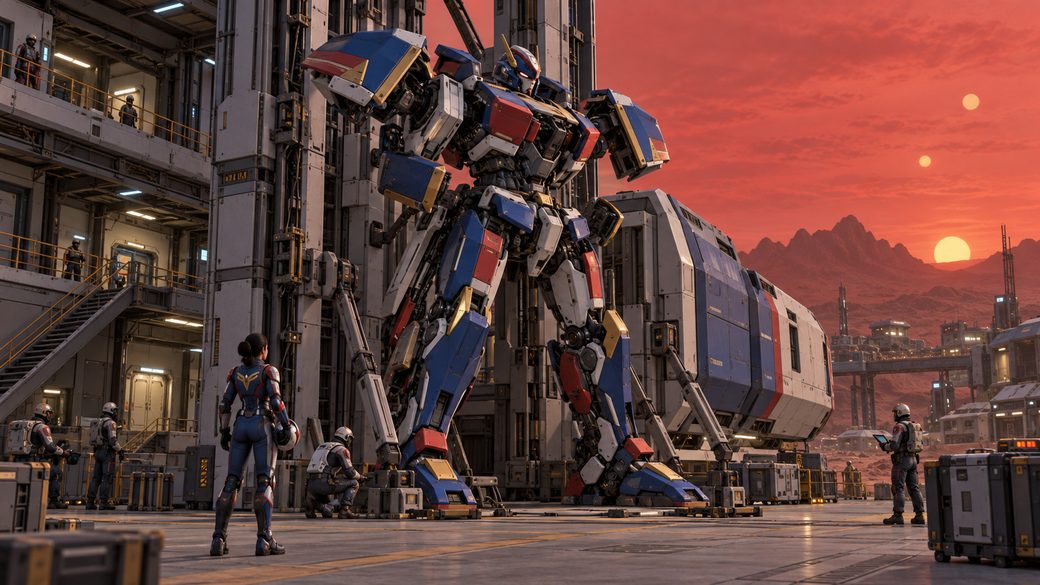
CY-), H-Crown. Heavy frames, transforming frames and the combiner lineage, out of a house that began by cutting ships apart at a breaking yard and has never entirely stopped. Held by Maren Chandler, born 3199, ninth in the female line from Neve Chandler and Keeper of the archive at Last Lantern. - Kestrel Line (prefix
KL-), Windrow. Aero and low-gravity airframes, the trainer most citizen-pilots learn on, and the rating schools that go with them. Held by Iven Kestrel, born 3208, who is also keeper of the sealed serial block his house has never reconciled. - Hearthmoor Concordat (prefix
HC-), Hearthmoor. Crew-served defense sets, settlement fortification and sustainment, priced off a schedule book kept continuously since 2571 and sold to whoever asks. Held by Bela Hearthmoor, born 3231, seated without argument, as every Hearthmoor has been since Ottel.
What they tell each other
- The Twenty-Two. That twenty-two imperial hulls were taken at once in the Longsight approach in 2863, and towed home by Wick, which has underwritten the Seven Worlds ever since. The receipts exist, signed by a boarding officer of twenty-five. They record eleven weeks, three separate positions and no single action, and the hulls went onto one schedule at Wick because Wick had the only intact bonded store in the Septet. The poorest world insures the other six on a filing convenience nobody wants to say aloud.
- The Eleven Days at Low Reach. That Tolan Kestrel lost Windrow in 2693 by cowardice, letting his flight rating expire at midnight in a warm room rather than fly in weather. He was airborne. A front closed behind him and he sat nine days at an outfarm strip with a serviceable frame and nobody authorized to sign an extension. The Roll struck a rating clerk for it instead, in the hand of the cousin who took the Seat by it, and never restored him, because restoring him would have conceded that an accession turned on the weather.
- Alba of the Long Card. That Alba Curlew flew one airframe out of Low Reach for ninety-five years and never took a second, and that a pilot who keeps one card keeps one life. There were three women, two of them unrelated. The card followed the frame rather than the pilot, because the assignment line was inked once in 3106 and never rewritten. The proof is in the harness store, where two fitting sheets for the same rig sit eleven centimeters apart in the torso.