
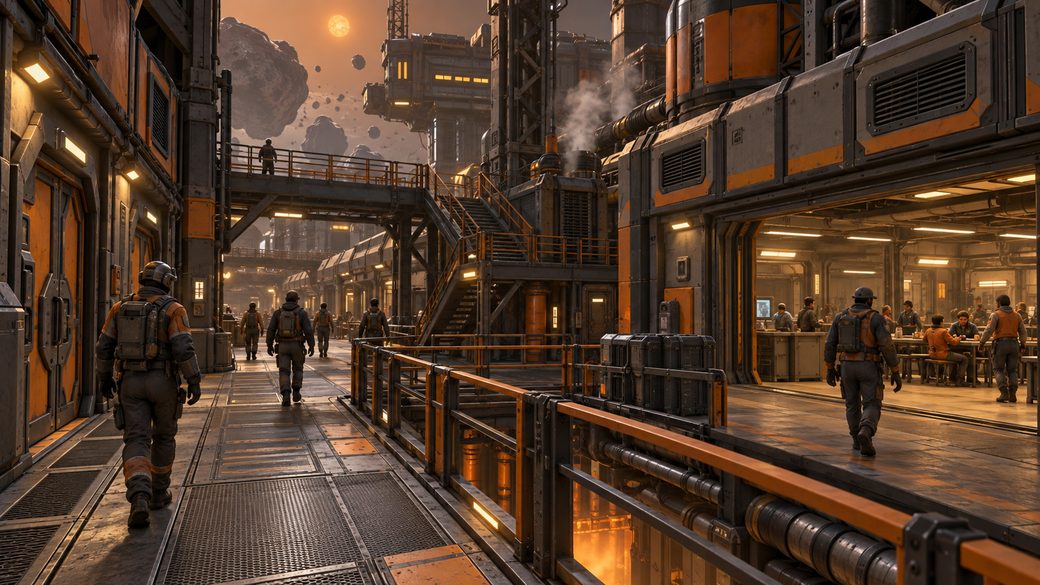
Eridani Directorate
The Eridani Directorate is the heavy industry of human space: armor plate, siege ordnance, structural section, propellant and drive assemblies, poured out of kilns that have not been allowed to cool since the imperial period. It is governed by a Chapter of six Forge-Duchies that elects one of its own as Director-Marshal for life, and it holds, with a straight face, that it never seceded from anything.
The Directorate's constitutional instrument is the Forge Compact, signed standing up on the pour floor of the Great Kiln at Forgehold on 19 Secondmonth 2900, because there are no chairs on a pour floor. It was signed eleven days before the Deed of Dissolution was executed at Sirius, and the timing was deliberate: a compact signed while the Sovereign still legally existed is a compact the Sovereign consented to.
Where other successor states abolished the imperial peerage or converted it, the Compact abolished nothing and confirmed everything. Article One kept every Writ of Foundry granted at Epsilon Eridani fully operative, heritable, and with its quota schedule unaltered. Article Two annexed the Marquess of the Halberd March's approach rights, inspection, toll and refusal to a new Writ of Foundry, converting a marcher lordship into the Forge-Duchy of Halberd with the Clause of Indifferent Trade of 2528 carried across verbatim. Article Three redirected every obligation formerly owed to the Sovereign to the Chapter of Forges sitting in common, and instructed the Chapter to elect one Forge-Duke as Director-Marshal, for life, to receive quota, enforce the writs and hold the Register. The document never mentions the Ascendancy's fall and never uses the word independence. The Directorate's position is that its paperwork simply continued while everyone else's stopped.
Character
Eridani thinks in schedules. Its founding insight, argued for four years by Ithel Ashkeep before anyone would listen, was that a crown which stops existing does not cancel a quota, but a quota owed to nobody stops being delivered. Ninety thousand people at Forgehold made plate to a schedule written in 2559, and a cold kiln at Epsilon Eridani takes eleven months and a fortune to restart. So the Compact was written to keep the schedule owed. Everything the bloc values follows from that: continuity, certification, the refusal to let a political argument interrupt a pour.
Consequently, political standing here is arithmetic. Under the Ordinance of the Bench a duchy in arrears on its certified quota may sit, speak and be elected, but may not vote. In the Directorate a Forge-Duke does not vote his blood; he votes his delivered tonnage. Elections are audits. Every succession requires the Assay of Entry, in which an heir must present the Bench with the duchy's quota certified paid current within 400 days of the death, and three consecutive years of suspension escheats the writ. The Iron Collar of the Director-Marshal is struck from the first pour after the ballot, which is the entire theology available to a foundry.
It is a bloc with genuinely honest instruments and a long record of using them dishonestly. The Bench of Assay is independent, its Assay-Master serving one non-renewable eighteen-year term, and it is still the body that suspended Talen Sorrelmark's vote in 3161 for a shortfall caused by a gate closure the Bench itself had ordered, on the reasoning that a closure is a fact and not an excuse. The ruling has never been overturned, because overturning it would unmake everything built on top of it. Nor was Berrin Ashkeep ever attainted for the shadow galleries of 2939, because attainder requires the Bench to certify an unpaid debt, and the debt had been paid, in a manner of speaking, by the dead.
What Eridani is bad at is people. The Compact has articles for tonnage, trust accounts and catalogue prefixes and none for a crew. Natural children are acknowledged, which confers a place in the works, a pension, a name and a burial, and confers nothing else. The 2,306 workers who walked off the Close Ring in 2939 were recorded as released, converting a labor event into an accounting adjustment, and no Eridani court has ever heard evidence about the unlogged deaths that caused it. The pension claims arising from it are the oldest live grievance in the bloc.
History
AK- and HD-, may leave the Directorate. Kade drive assemblies, Vetch habitat frames, Draywell volatiles and Slakewater remelt have shipped under other houses' marks ever since, and it remains the most resented act of Eridani governance.Houses
Only two catalogue prefixes may leave the Directorate. Everything else the bloc makes is delivered into one of them.
- Ashkeep Foundry (prefix
AK-), the Great Kiln at Forgehold. Armor plate, structural section and siege ordnance, built around Ashbone Laminate, a bed ash calcined in refractory ware and fired past the point any sane house stops, which work-hardens above roughly sixty percent core temperature. The doctrine follows the material: stand in the gate mouth and let the enemy make it worse. The senior founding grant of the Register, held by Serrin Ashkeep, born 3199. - Halberd Ordnance Bureau (prefix
HD-), Halberd March Station on the gate approach. Quiet ware, pointing tooling and dossiers, sold under the Clause of Indifferent Trade of 2528, the only writ in human space carrying the right to sell without regard to flag. Its real asset is the Register of Passage, begun in 2513 by the founder's wife Tess Quaile, a consignment factor who understood that a marcher lord is not an arms dealer but a man who knows what is inside things he may not open, and can sell the knowing. Held by Vesla Halberd, born 3219. - Kade, Kade Cut and the old barony works at Ninebar. Drive assemblies, rotors and frame skeletons, nine hundred frames a year for three hundred years, all of it shipped stamped
AK-. The house holds the crown: Director-Marshal Oren Kade, born 3211, whose ducal writ is surrendered into trust for his reign. - Draywell, Vetch and Slakewater. Volatiles, propellant and coolant from Draywell Sink under Ilva Draywell; habitat manufacture, fasteners, pressure fittings and the labor registry of the whole bloc from the Vetch Anvil under Tam Vetch; reclamation, breaker yards and remelt from Slake Deep under Gerrit Slakewater, who succeeded at nineteen with the duchy in arrears and was carried through his Assay of Entry by a loan he is still repaying.
What they tell each other
- The Eleven Hours. That in 2863 an Ashkeep siege frame stood in a gate mouth for eleven hours at ninety-one percent core heat, hardening as it burned, and broke an assault alone. Two records support it and neither can be reconciled with the other, because they describe different actions a year apart. Heat nineteen went out as sixteen frames sharing one number. One of them held the Ninth Gate against a customs raid in 2862; a different one stood the eleven hours in 2863. Both accounts are honest. The dorsal plate of the first was built into a tally office wall as a bench back in 2871 and is still there.
- Ottiline Kade and the chute. That she came out of the sealed Assay Hall in 3161 with the Forge-Duchess's body and the certified tonnage rolls both, through a chute welded half shut, and lost her hands doing it. She left the body. The recovery sheet has Ilva Vetch off the floor on the seventh day. Asked by the Bench in 3171 why, she said she could carry the rolls or the woman. Her duchy was another house's price for a vote, and the account of it was cut in 3164 by a herald working for a house three years old and short of ancestry.
- The Relief of Cinderhall. That when the habitat spine failed across four rings in 3098, ducal hulls cut through in ninety minutes and pulled two thousand people clear, which is why the dead were four thousand and not six. The spine failed in ninety seconds and the lane register for that day shows no ducal movement at all. One breaker tug arrived nine hours late and took off eleven people. Their names are written on the reverse of its fuel ticket and in no other book.